Best Freight Forwarder from China to Canada | Your Complete Guide
Editor-User
August 9, 2026
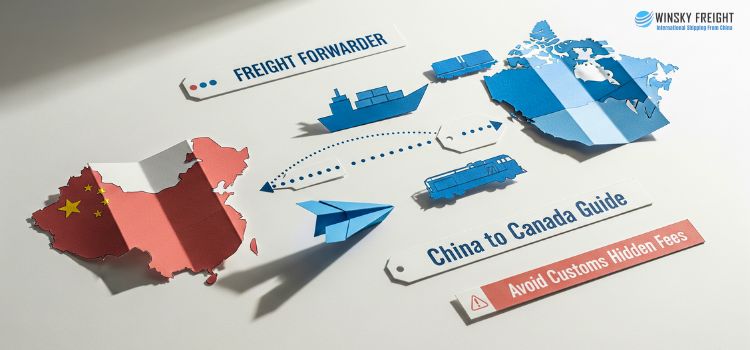
Breaking: Slip-up on new CARM rules can cost you over $500 per day on your shipment from China to Canada!
Now, CBSA wants you to maintain everything from a simple HS code to the digital declaration.
This guide helps you learn the recent logistics landscape, comparing Air vs. Sea freight forwarding from China to Canada for maximum ROI.
You’ll also discover the hidden pricing structure, compulsory CBSA protocols, and consolidation strategies to reduce the landing cost by 25%.
Read on…
Table of Contents
| Section | Key Findings |
|---|---|
| 1. What Importers Must Know About the Current Logistics Landscape | Having a digital profile and CARM compliance are now mandatory hurdles for Canadian importers. |
| 2. Air vs. Sea vs. Express: Making the Choice | Air freight wins for speed (<10 days), while sea freight dominates for bulk savings (>500kg). |
| 3. Breakdown of Shipping Costs & Rates | Chargeable weight and seasonal peaks (Q4) are the biggest drivers of shipping expense variance. |
| 4. Customs Clearance Maze: CBSA & Compliance | Accurate HS codes and understanding GST/Duty rates are non-negotiable for clearance. |
| 5. How to Find a Reliable Freight Forwarder? | Transparency in pricing and specific expertise in your niche are top vetting criteria. |
| 6. 7-Step Shipping Process From China to Canada | A clear 7-step roadmap from supplier pickup to final door-to-door delivery. |
- What Importers Must Know About the Current Logistics Landscape?
- Air vs. Sea vs. Express from China to Canada: Making the Right Choice
- Breakdown of Shipping Cost from China to Canada
- How To Reduce Shipping Cost from China to Canada?
- Customs Clearance Maze: CBSA & Compliance
- How to Find a Reliable Freight Forwarder?
- Must-Know Red Flags When Hiring a Freight Forwarder
- 7-Step Shipping Process From China to Canada
What Importers Must Know About the Current Logistics Landscape?
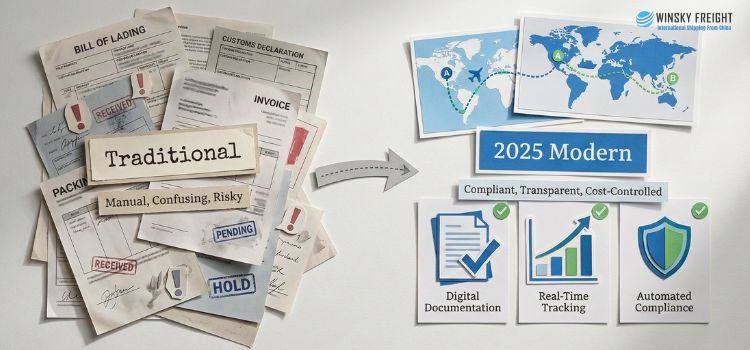
By the final quarter of 2025, the logistics bridge that connects China and Canada has evolved through new technologies and regulations.
These days, you can’t just settle for a carrier and forget the rest. You need to understand the environment they operate in.
As already mentioned, a major development is the full execution of the CBSA Assessment and Revenue Management (CARM) project.
With this digital tool from the Canada Border Services Agency, duties and taxes are collected differently, and now the onus is on importers. Count it like a government approach to make importers more proactive with security and declaration.
As “Green Logistics,” we see shipping lines adapting to low-sulphur fuels.
Undoubtedly, it’s great for the environment. But this has also created additional complexities in the fuel surcharge calculation.
In addition, the post-pandemic supply chain has stabilized, but it’s still vulnerable to seasonal peaks.
With AI in logistics, we can see more optimized route solutions. The best use of these tools requires an expert freight-forwarding partner to import from China to Canada. Because only they can predict the delays beforehand.
Air vs. Sea vs. Express from China to Canada: Making the Right Choice
Your importer career success vastly depends on the mode of transport you choose. To make the right choice, you’ve to consider the supply chain efficiency, the budget of each model.
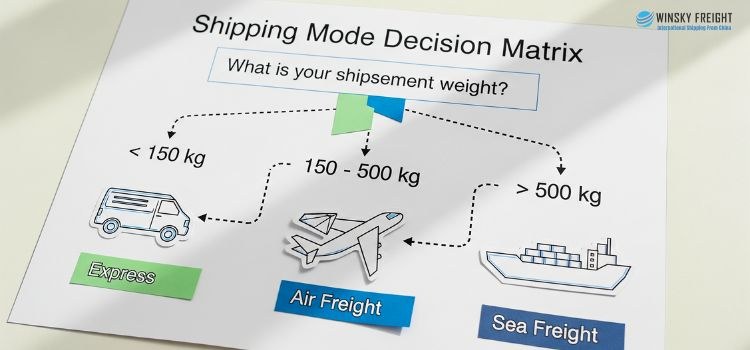
Note: There’s no one-size-fits-all solution. Each of these has both odd and even.
1. Express Shipping from China to Canada(Courier)
If you plan to ship less than 150 kg, express shipping is the way to go. You can get your parcels directly at your doorstep.
It’s basically what companies like DHL, UPS, and FedEx tackle. The courier company will handle the customs clearance process on behalf of you. However, you’ve to carry to duty bills.
- Best For: Starters, samples, urgent shipments
- Delivery Time: 2-5 days
- Pros: Fastest, tracking ability, easy paperwork
- Cons: Cost you the highest per kg compared to other methods
2. Air Freight from China to Canada
If your shipment is anywhere between 150 kgs to 500 kgs, air freight is a viable method. It doesn’t deliver you directly to your door, but rather transports products from one airport to another airport (ex, Shanghai PVG to Vancouver YVR or Toronto YYZ).
So, you’ve to arrange a last-mile delivery carrier or maybe hire a forwarder to get the delivery to your destination.
- Best For: Mid-sized shipments, restocking faster
- Delivery Time: 5-10 days
- Pros: Faster than sea route shipments, little insurance risk, predictable schedules
- Cons: A Strict regulatory system, especially for hazardous products such as batteries
3. Sea Freight from China to Canada
Perhaps, the most popular and cost-efficient method for importers with large quantities in line is sea freight.
It’s advisable if your order quantity is more than 500 kgs or something bigger in size.
There are 2 types of sea freight features you’ve to choose from: LCL (Less Than Container Load) and FCL (Full Container Load).
LCL allows you to load your goods in a shared container so that you can split the cost with other importers, ideal for 1-15 CBM.
On the contrary, for FCL, you’ve to book a whole container sized from 20ft to 40ft, ideal for 15+ CBM.
- Best For: Large-sized shipments, machinery, furniture
- Delivery Time: 15-25 days to the West Coast (ex, Vancouver) and 25-40 days for the East Coast (Toronto or Montreal)
- Pros: Lowest cost per unit, limitless capacity
- Cons: Slowest transit, rough handling during load and unload
So, what’s the way to go?
It really depends on your specific needs and the suitability of the freight method. For instance, the regulations for hazardous items are different in air transport vs sea transport. Make sure to discuss hazardous goods regulations with your forwarder.
Breakdown of Shipping Cost from China to Canada
It can sometimes feel like you’ve to speak a different language in order to interpret a freight quote. Always directly ask the forwarder about the full price, including if there’s any hidden costs that might be called afterward.
Chargeable Weight: The “Hidden” Multiplier
One of the biggest misconceptions is thinking that actual weight and chargeable weight are the same. Well, they are not.
Your shipment carrier will use the higher of either the scale’s gross weight or the volumetric weight (the amount of space your load takes up).
- Air Freight Divisor: Usually 1:167 (here, 1 CBM equals 167 kg).
- Express Divisor: Typically 1:200 (here, 1 CBM equals 200 kg).
- Sea Freight: Often charges per CBM (LCL) or per Container (FCL).
Cost Breakdown Structure
Ensure the information mentioned below is in your forwarder’s quote. If not, ask them to include.
- Pickup Fees (EXW): Charges for relocating your products from the port of origin (or factory)
- Origin Charges: Export paperwork, handling, and consolidating fees.
- Freight Rate: The freight rate is the price for the main leg (air or sea) of the journey.
- Canadian Charges: Port handling fees (DTHC), warehousing, deconsolidation, and deriving each source of assortments.
- Customs and Duties: Government tariffs for CBSA and agents’ brokerage fees.
- Last-mile Destination Charges: Delivery fees for a truck or train.
How To Reduce Shipping Cost from China to Canada?
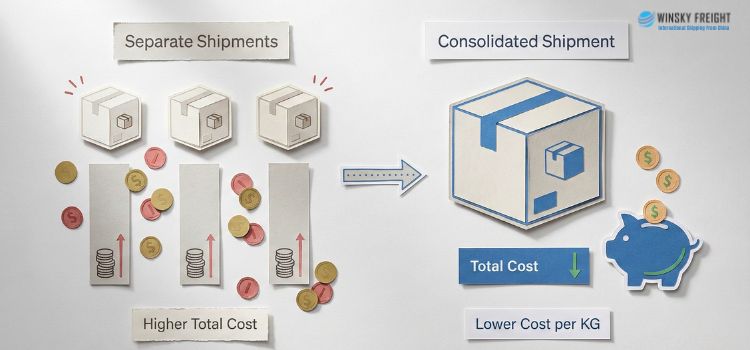
Some experienced importers use these techniques to lower the cost of shipping. And that’s not illegal, but rather intellectual strategies.
Among all of them, the most effective one is freight consolidation. See, practically, it becomes costly to pay for 3 different small LCL shipments when buying from three suppliers in China.
So, instead, expert forwarders collect your all three shipments and store them in their origin (Chinese) warehouse.
As most of the time they have free-sourcing periods, they can later merge them into one bulk shipment.
This way reduces your cost per item for shipping and also makes clearing customs at the Canadian border far easier.
Customs Clearance Maze: CBSA & Compliance
Getting the goods to the Canadian border is only half the battle. The other half is getting them into Canada legally. Our Canada Border Services Agency, or CBSA, isn’t lenient. If you don’t comply, your goods can be seized, and sometimes you may get fined.
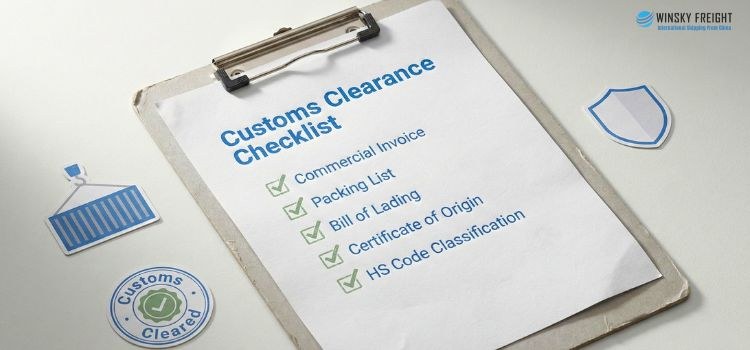
Importance of HS Codes
Every product has a specific Harmonized System (HS) code, usually consists of 10 digits.
Your product’s HS codes decide how much duty rate you’ve to pay to the government.
Please, don’t mislabel your product–as in a leather shoe is declared as a textile shoe. In such cases, you may get penalized, and there can also be a retroactive duty bill.
Before finalizing your Commercial Invoice, we strongly advise consulting a guide on what an HS code is.
Duties vs. GST
As an importer, you’ve to have a firm grip on Customs Duties and GST (Goods and Services Tax) related costs.
Like most countries, the Canadian government charges a fee as customs duties on your imported products. The charge varies depending on the origin country.
On the other hand, you’ve to pay a 5% GST, which is calculated on the duty-paid value of your goods.
| Topic | Customs Duty | GST (Goods & Services Tax) |
|---|---|---|
| Administered by | Customs Tariff (by CBSA). (Canada Border Services Agency) | Excise Tax Act or CRA rules; collected by CBSA and remitted to CRA. (Canada) |
| Rate decision-maker | Federal Customs Tariff | GST/HST rules set by CRA. |
| Rate range | Depends on HS codes. Duty rates can be 0% up to ~18–20% | 5% federal GST on taxable imports |
| Valuation | Calculated on the Value for Duty (VfD). | Calculated on the Canadian dollar value of goods, value for duty (VfD) (any duty and excise taxes may apply) |
| Who pays | Importer of Record (IOR) — commonly the consignee or the customs broker | Importer of Record |
| When collected | During the importation, when reporting goods to CBSA. | Same |
| Preferential/Exemptions | Reduced or even ZERO rates may apply if importing under a valid free trade agreement. | Generally, applies unless an exemption explicitly applies. |
| Low-value / e-commerce treatment | Sometimes ZERO for a few low-value shipments if mentioned in tariff rules and carrier programs. | Applies to most mail and courier imports, unless collecting at the seller/marketplace tax stage. |
| Find the exact amount | Using Customs Tariff (T2025) Finders, look for 8- or 10-digit tariff items. | 5% GST to (VfD + duty + excise). |
Role of Customs Brokers
In case you’re not going to the customs office yourself to clear the importing goods (most businesses don’t, as it’s time-consuming and stressful), you need to partner up with a customs broker.
Sometimes, freight forwarders offer this as an integrated service and charge shipping, clearance, and brokerage fees as a one-stop solution.
Practically, this makes sense to any business owner, as there’s no chance of frequent miscommunication.
How to Find a Reliable Freight Forwarder?
Frankly, there are thousands of freight forwarders you can find both online and offline. The main challenge is to filter them to pair up with the trusted one.
We’re gonna be totally selfless and share with you what to look for. But before that, remember one core thing: in the freight world, “Cheap” means “Hidden Fees” + “Delayed Shipments”.
Ask these four questions when shortlisting your freight forwarder to import from China:
- Do you have a physical warehouse or office in China? – Answer tells whether they can oversee goods and consolidate shipments.
- Can you share your experience with importing some specific (your) product categories? Answer gives you an idea of their expertise in handling requirements for different product types like batteries, foods, textiles, etc.
- Can you provide a detailed cost estimation item by item? – Answers should give you an understanding of “what costs for what”.
- Do you handle DDP services for Canada? – Answers give you an understanding of whether they are offering to tackle Canadian customs formalities or not
Must-Know Red Flags When Hiring a Freight Forwarder
Always steer clear of the forwarders offering a very low price compared to the market standard. This type of forwarder uses price as bait for new importers.
They will scam you later by holding your “Bill of Lading” for emergency fees.
To put yourself in the safe zone, ensure you ask them if they can issue the bill of lading and ask for their business verification license.
Also, ensure checking their reviews on trusted customer portals for importers.
Regarding the market standard quote, ask for price from multiple companies, shortlist the relatively similar prices, make an average of that–you’ll get the idea.
How to save yourself from freight forwarder scammers is more like common sense rather than complex math.
7-Step Shipping Process From China to Canada
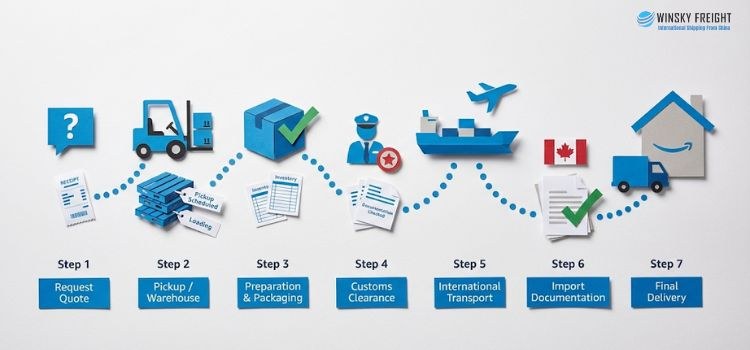
The SOP (standard operating process) is pretty much the same in trusted freight forwarder companies. Here’s how Winsky Freight (we) take control of your shipping where keeping you always in the loop:
- Step 1 – Quotes & Booking: You provide us with the details such as weight, volume, Intercoms of your cargo or products. After a short inspection, we’ll send you the price list.
- Step 2 – Pickup: We’ll pick up your goods from the supplier’s factory or warehouse. Sometimes suppliers may send them to our warehouse in China.
- Step 3 – Cargo Checking and Preparations: Next, we’ll inspect the packaging–weighing the cargo to determine the actual chargeable weight, add important labels (like for Amazon FBAs, vice-versa)
- Step 4 – Export Customs in the Origin Country: We’ll handle all the customs formalities in China.
- Step 5 – International Transit: Depending on your decided preference, we’ll send the goods via Air or Sea route. Either way, you’ll receive a tracking number to check on the live status of the cargo.
- Step 6 – Import Customs in the Destination Country: Before the arrival of your cargo, we’ll submit a B3 form to the CBSA along with customs duties.
- Step 7 – Last-mile Delivery: Upon getting the release of your shipment at the port, we’ll process the delivery to your selected location, maybe your home or factory, or warehouse.
So, basically, we tackle all things on your behalf in the best way to minimize the cost legally.
Conclusion
Shipping from a completely new country, new people always come with risks. Most starters make it even worse by partnering up with the wrong forwarders. A reliable freight forwarder to bring your goods from China to Canada won’t,
- Offer you the lowest price per KG, rather brutally mention the right price,
- Ask your preference for the route, rather than tell you whether you should import via Air or Sea Freight.
- Lure you with schemes to import products illegally to bypass the system, rather than tell you the process to optimize the customs complexities.
If you want to practically grow your import business with strategic support, Winsky Freight can help you out.