Sea Freight from China to Canada: The Ultimate Guide
Editor-User
August 14, 2026
Breaking: December 2025 has been a chaotic period for Canadian importers. The government implemented a new CARM system. It completely changed how you used to handle customs to import goods from China!
Whether you’re a side-gigger, Amazon FBA seller, or an established business, you want to secure the best freight rate. Don’t you?
But during the peak season of the Chinese New Year rush, along with new strict compliance rules, navigating the Pacific route required a lot of precision.
You can’t blame the Canadian government. Since sea freight accounts for 90% of the goods import of the country, these strict rules were expected.
To make your every shipping from China to Canada profitable, now, you’ve to be smarter with port selections, documentation, following the latest customer regulations.
That’s what you’re gonna discover in this guide. Let’s head into it…
Table of Contents
| Section | Key Takeaways |
|---|---|
| 1. Why Choose Sea Freight? | Best for bulk shipments (>100kg). |
| 2. FCL vs. LCL Modes | FCL is faster and safer; LCL is budget-friendly for small loads. |
| 3. Transit Times | West Coast takes ~15-25 days; East Coast takes ~30-45 days. |
| 4. Cost Factors | Rates fluctuate based on fuel, seasons, and container availability. |
| 5. Canadian Customs (CARM) | Importers must register on the CARM Client Portal. |
| 6. Shipping Process | A 6-step flow from supplier pickup to final doorstep delivery. |
| 7. Reducing Costs | Choose FOB, optimize packaging, advance booking, check HS Codes |
- Why Choose Sea Freight from China to Canada?
- FCL vs. LCL: Which Shipping Mode Fits Your Business?
- How Long Does it Take For shipping from China to Canada?
- Sea freight cost from China to Canada
- Navigating Canadian Assessment and Revenue Management
- Step-by-Step Shipping Process with Winsky Freight
- How to Reduce Shipping Costs When Importing From China?
Why Choose Sea Freight from China to Canada?
Before jumping into the current sea freight guide, maybe you should also understand why people choose the ocean route over Air Freight from China to Canada.
The short answer is–it’s more economical when it comes to scaling your import venture.
You can easily hold 10,000+ t-shirts or maybe 100s of heavy machinery parts in a 40-foot container.
That way, you can significantly reduce the shipping cost per unit–it’s around pennies.
Yep, there’s a hitch too! While air freight takes around 3-7 days to complete a delivery from Shanghai to Vancouver, sea freight usually takes 14-18 days.
Let’s check out the necessary steps you should take into consideration if going for sea route.
FCL vs. LCL: Which Shipping Mode Fits Your Business?
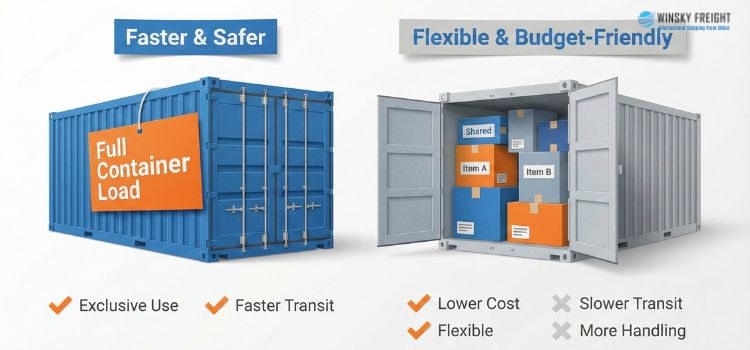
China to Canada sea freight offers two methods of loading: Full Container Load (FCL) and Less Than Container Load (LCL)
Full Container Load (FCL)
It’s when you rent an entire 20ft, 40ft, or 40HQ container for your products. Whether you fill it completely or not, you’ve to pay the full charge for the container.
Pros
- Cost-effective if importing high-volume shipments of more than 15 CBM
- Transit is fast, as there’s no multi-step checking until reaching your destination
Cons
- Not budget-friendly for low quantity orders
Before proceeding, you’ve to check out the FCL current spot rates.
Less Than Container Load (LCL)
LCL, as you can guess, allows you to import goods in shared containers. So, you only pay for the CBM (cubic meter) your products occupy.
Pros
- Suitable for importers may use up to 15 CBM at max
- Allows frequent and smaller volume shipments
Cons
- Consolidation (at origin) and deconsolidation (at destination) increase the shipment time
Note: Now, you can follow the freight consolidation approach to combine multiple small batches of shipping to save more money
How Long Does it Take For shipping from China to Canada?
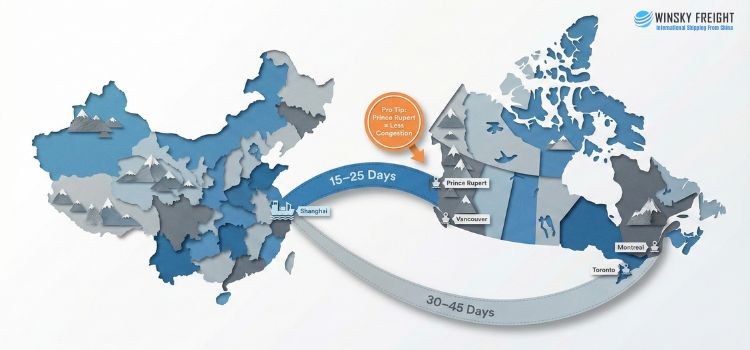
Here comes the real dealbreaker decision if you’re a Cyclical importer–understanding the shipment duration. And honestly, it varies a lot since Canada is vast.
So, it really depends on whether you’re shipping to the West Coast, like Vancouver or Prince Rupert, or the East Coast, such as Montreal or Toronto.
| Route (China to Canada) | Port-to-Port Time | Door-to-Door Estimate |
|---|---|---|
| Shanghai to Vancouver | 14 – 18 Days | 30 – 40 Days |
| Shenzhen to Prince Rupert | 12 – 16 Days | 28 – 38 Days |
| Ningbo to Toronto (via Rail) | 22 – 28 Days | 35 – 40 Days |
| Qingdao to Montreal | 28 – 35 Days | 40 – 50 Days |
Pro Tips:
Settle for routing through Prince Rupert in case your desired destination is in Central Canada or the Midwest. As situated closest to the North American port to Asia, shipments through this route experience less congestion unlike Vancouver.
Consideration 3: Cost of Sea Freight
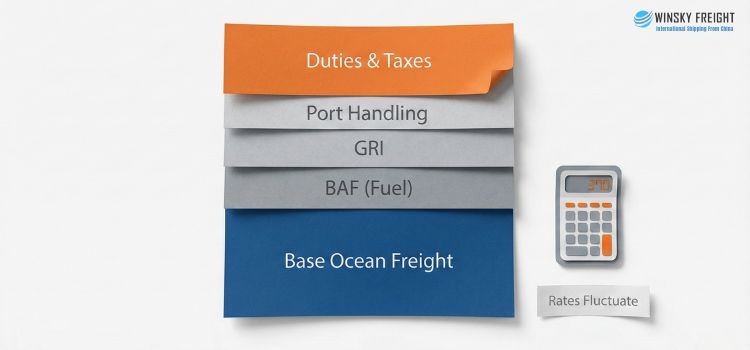
Sea freight rates are erratic, often influenced by the rush seasons (eg, Chinese New Year). Another culprit is the relentless fuel surcharges.
And why these matters?
Because each of them impacts your freight rate.
- First, Ocean freight has a base cost
- Second, BAF (Bunker Adjustment Factor) is the rising fuel charge
- Third, GRI (Generate Rate Increase), which gets changed every month by your carriers
- Fourth, Port Handling Fees or the loading/unloading charges in China and Canada
- Fifth, Customer Duties and Taxes imposed by the Canadian government
You can get a more accurate understanding of the cost, summing up the chargeable weight for LCL volume (1 CBM = 1,000 kg).
Navigating Canadian Assessment and Revenue Management
As mentioned earlier, aligning with the new compliance of CARM (CBSA assessment and revenue management) is by far the biggest challenge for first-time importers.
In the past, your customs broker could handle the whole shipment process on your behalf. But that’s no longer possible with this update.
We strongly advise you to complete your profile registration on the CARM Client Portal (CCP). If you don’t, your shipment will be stuck at the border.
Essential Documents for Registration:
- Bill of Lading (B/L) – Carriage master contract
- Commercial Invoice
- Packing List
- Certificate of Origin – Mandatory to claim reduced customs duties
Step-by-Step Shipping Process with Winsky Freight
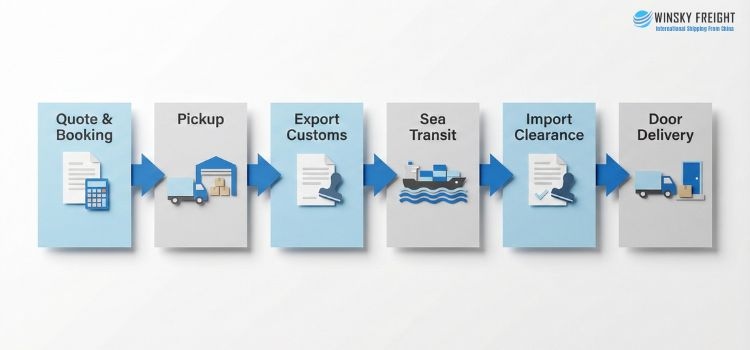
Your shipping won’t feel chaotic like others if tackled by professionals. With Winsky Freight, the process looks like this:
Step 1 – Quote and Booking: Just provide us with the cargo details. You can get quotes for both FCL and LCL
Step 2 – Pickup: Next, our team in China collects your goods from the supplier’s factory or warehouse.
Step 3 – Export Customs: Winsky Freight handles the Chinese export declarations.
Step 4 – Sea Transit: Your products come through the Pacific, and you can track their real-time location 24/7
Step 5 – Import Clearance: Our team in Canada takes care of Canadian customs clearance, using your CARM account.
Step 6 – Door-to-Door Delivery: Finally, we arrange the trucking of your goods to your home or warehouse.
How to Reduce Shipping Costs When Importing From China?
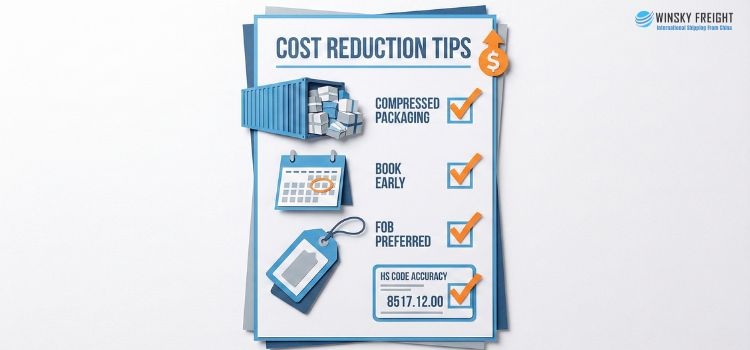
Minimizing shipping costs really depends on your smart decision at the right time. This is what we suggest to our clients:
Choose FOB: Free On Board basically ensures your suppliers cover the cost of the Chinese port. It’s better than EXW (Ex Works) where you’ve to pay for all charges starting from the factory.
You can also consider DDP shipping to let your forwarder handle duties and deliveries.
Optimize Packaging: Warn your supplier to avoid packing your products loosely. Efficient palletizing can minimize the CBM significantly.
Book in Advance: Don’t book shipping during December or January. Your budget will be crushed by the PSS (Peak Season Surcharges). Secure your spot 3-4 weeks before the rush.
Must Check HS Codes Early: HS codes determine your duty rate. Having the wrong code leads you to pay more taxes and even penalties. Don’t take it lightly; verify before shipping starts.
Conclusion
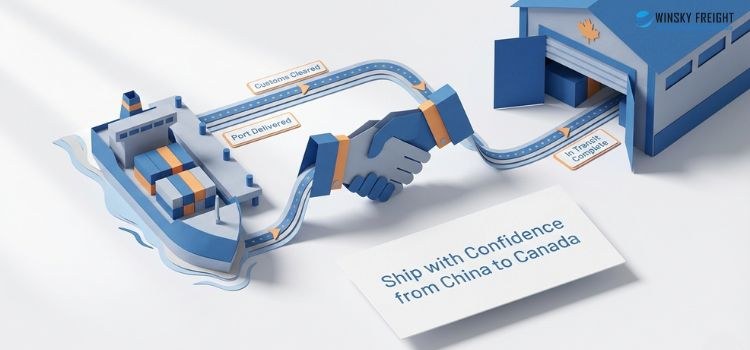
Shipping via sea freight from China to Canada is more about strategic planning, ticking all the boxes of regulatory compliance.
Beginning with selecting the right port, confirm CARM registration, handle customs, unloading/trucking–each step matters to protect your bottom line.
We’re doing these all for thousands of Canadian importers. By partnering up with Winsky Freight, you don’t have to go through the water alone.
Contact us to bring your next shipment home safely.