China To Canada Shipping Time (Latest Guide) | Winsky Freight
Editor-User
September 10, 2026
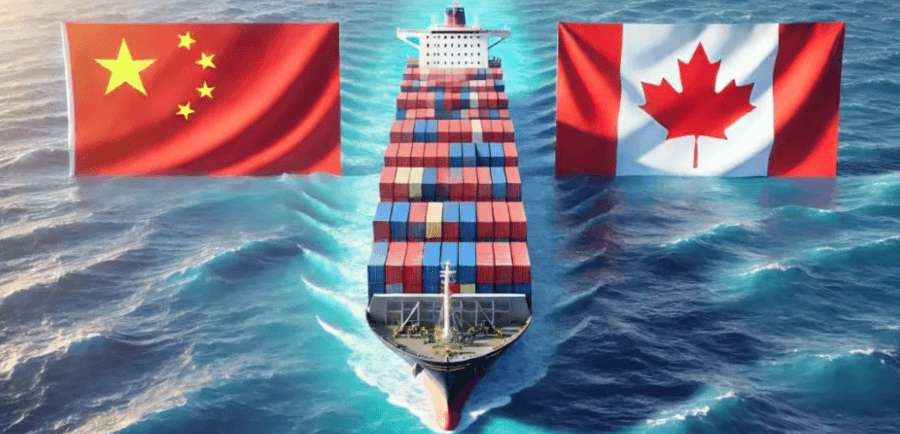
China to Canada shipping time depends on the method you choose, the routing, customs processing, and how far the final-mile delivery has to go.
And here’s the part that trips people up.
Transit time and door-to-door time are not the same thing.
If you want predictable delivery, you need to plan the whole timeline, not just the flight or the sailing.
- How Long Does Shipping from China to Canada Take (Door to Door)?
- How Long Does Express Shipping from China to Canada Take?
- How Long Does Air Freight from China to Canada Take?
- How Long Does Sea Freight from China to Canada Take (LCL Vs FCL)?
- What’s The Difference Between Port-To-Port Time and Door-To-Door Time?
- Does China Ship Directly to Canada or Via Transshipment?
- Which Route Is Faster: West Coast (Vancouver/Prince Rupert) Or East Coast (Toronto/Montreal/Halifax)?
- What Factors Affect China to Canada Shipping Time the Most?
- What Causes the Biggest Delays When Shipping from China to Canada?
- How Does Peak Season Change Shipping Times?
1. How Long Does Shipping from China to Canada Take (Door to Door)?
Door-to-door shipping from China to Canada usually takes a few days to several weeks, depending on the shipping method, destination, and customs clearance process.
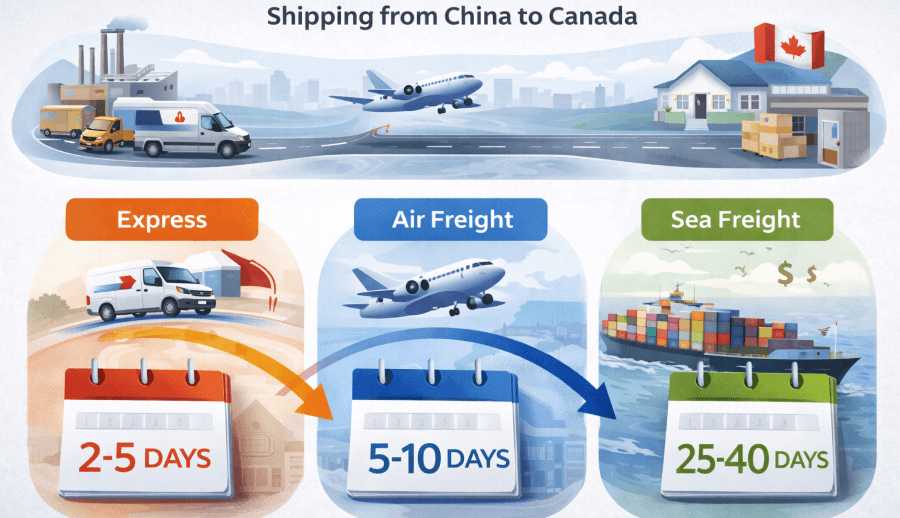
So, let’s see how the shipping method you choose affects transit time China to Canada.
With express shipping, expect your goods to reach your doorstep within 2-5 days.
But with Air Freight, you’ll have to wait for around 5-10 days.
Although economical, Sea Freight takes the longest time – around 25-40 days.
Looking at the customs clearance, shipping might take a bit longer than expected if the process at the Canadian port is lengthy.
Your final destination also matters – that’s the distance between the port and the final destination in Canada.
For instance, your goods might take 3-4 days longer to arrive if the final destination isn’t a coastal city, say Edmonton, Toronto, or Montreal.
2. How Long Does Express Shipping from China to Canada Take? (LCL vs FCL Door-to-Door Time)
Express shipping from China to Canada typically takes 2–5 days door-to-door, making it the fastest but also the most expensive option.
LCL Vs FCL Door to Door Shipping Time China to Canada Comparison
| Shipping Method | Door-to-Door Time | Predictability | Best For |
|---|---|---|---|
| Express Shipping | 3–7 days | ⭐⭐⭐⭐⭐ | Urgent documents, samples |
| Air Freight | 5–10 days | ⭐⭐⭐⭐ | Time-sensitive cargo |
| Sea Freight (LCL) | 25–40 days | ⭐⭐⭐ | Small, cost-focused shipments |
| Sea Freight (FCL) | 25–35 days | ⭐⭐⭐⭐ | Full container shipments |
Express shipping is your best bet if you want your shipment from China to arrive in Canada within 2-5 days.
It’s the best method for shipping small, fragile items weighing less than 20 kg, especially for emergency or urgent deliveries.
If you live in a major city like Vancouver or Toronto, your express delivery can reach the final destination in Canada within 3 days.
3. How Long Does Air Freight from China to Canada Take?
Air freight time China to Canada is around 5–10 days door-to-door, depending on flight availability and customs clearance.
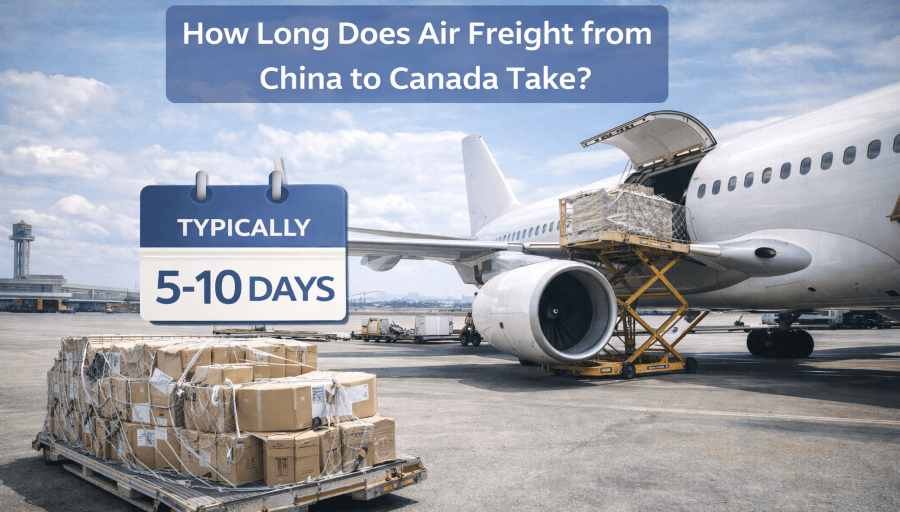
Air freight is kind of the “in between” option – not express, but not sea freight either.
Typically, it takes a good few days – up to 10 days door to door, depending on how the shipment is handled and where it’s ending up in Canada.
Here’s where people often get caught out: they assume air freight means next-day, but really, it’s pickup, cargo handling, airport processing & local delivery that are still in the mix.
If your shipment has any special items, such as batteries or liquids, or requires extra compliance, air freight can slow right down.
4. How Long Does Sea Freight from China to Canada Take (LCL Vs FCL)?
Sea freight time China to Canada is around 20 to 50 days, with FCL shipments usually faster and more predictable than LCL shipments.
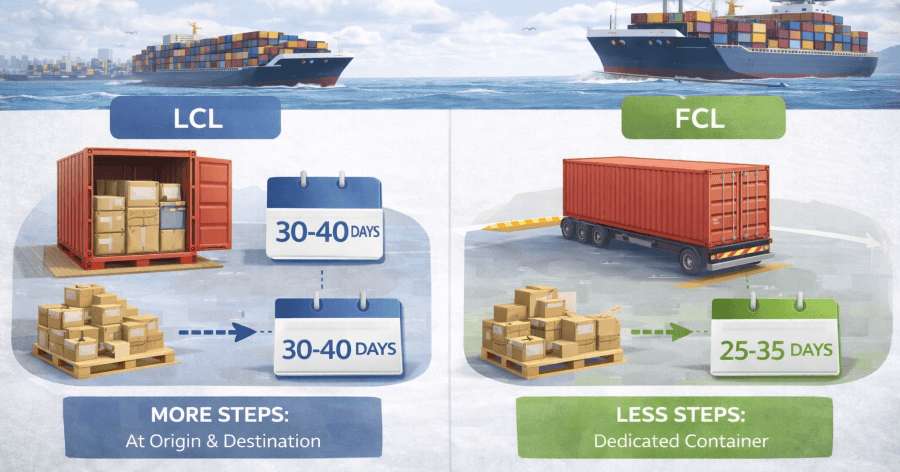
If you plan to transport big volumes of goods from China to Canada with FCL (Full Container Load), expect your shipment to arrive in Canada within 25-40 days.
But with LCL shipping, it usually takes slightly longer, around 30-50 days of waiting.
Remember, LCL is a consolidation service in which your cargo is combined with other shippers’ cargo before being shipped.
Then, once it arrives, it gets broken apart again for individual delivery. Unfortunately, these extra steps delay shipping.
Also, in some cases, the port-to-port route you choose can make your shipment arrive in Canada sooner or later.
For instance, shipping from Shanghai to Vancouver would take around 14-20 days, while shipping to inland destinations like Toronto would take 25-40 days.
5. What’s The Difference Between Port-To-Port Time and Door-To-Door Time?
Port-to-port time is the shipping duration from the origin port to the destination port, whereas door-to-door time covers the entire journey from the supplier’s door to the recipient’s.
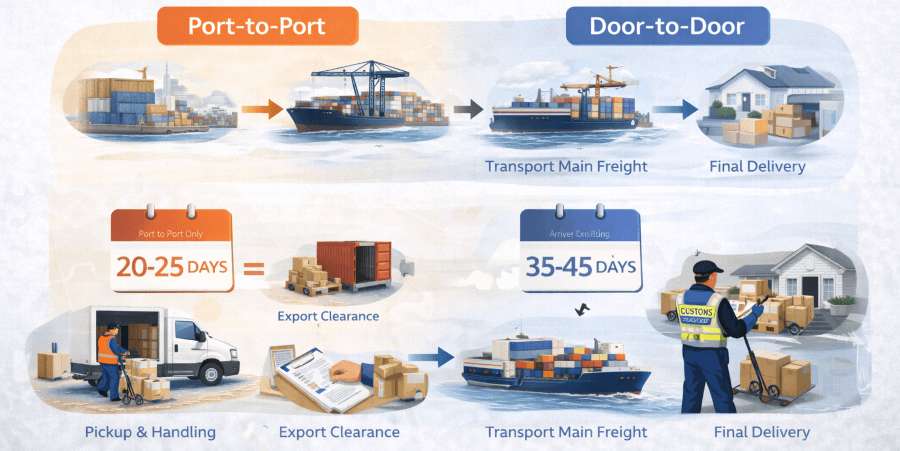
Door-to-door shipping time from China to Canada is longer, around 35-45 days, as it involves extra steps: picking and handling, inland transport, and export clearance.
But with port-to-port shipping, the time is shorter, around 20-25 days, as it ignores the time spent before the shipment reaches the port and after it arrives.
While port-to-port shipping is shorter and cheaper, the shipper or consignee must oversee additional logistics, which can be costly.
6. Does China Ship Directly to Canada or Via Transshipment?
Shipments from China to Canada can move either directly or via transshipment, depending on carrier schedules, ports, and capacity.
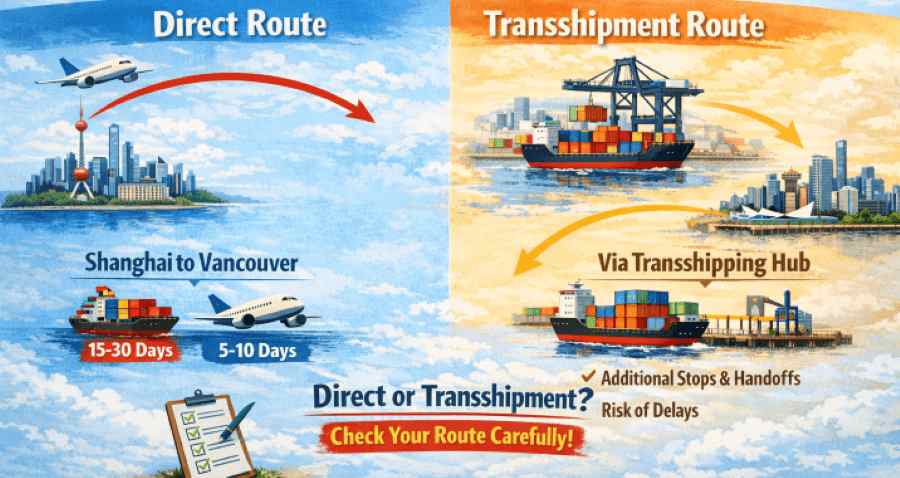
Shipping directly from China to Canada is primarily between major ports in both countries.
For instance, if you’re shipping directly from Shanghai to Vancouver, it will take 15-30 days, while air freight takes 5-10 days.
But sometimes your cargo is sent to another hub before it even reaches Canada, a process known as transshipping.
And don’t get it twisted – transshipping isn’t always a bad thing.
But it can be a bit of a wild card.
If you’re dealing with tight deadlines, you’ll want to double-check how your shipment from China will get to Canada.
Transshipping might add a few extra handoffs and increase the risk of delays.
7. Which Route Is Faster: West Coast (Vancouver/Prince Rupert) Or East Coast (Toronto/Montreal/Halifax)?
West Coast routes (Vancouver, Prince Rupert) are usually faster than East Coast routes due to shorter ocean transit and inland delivery distance.
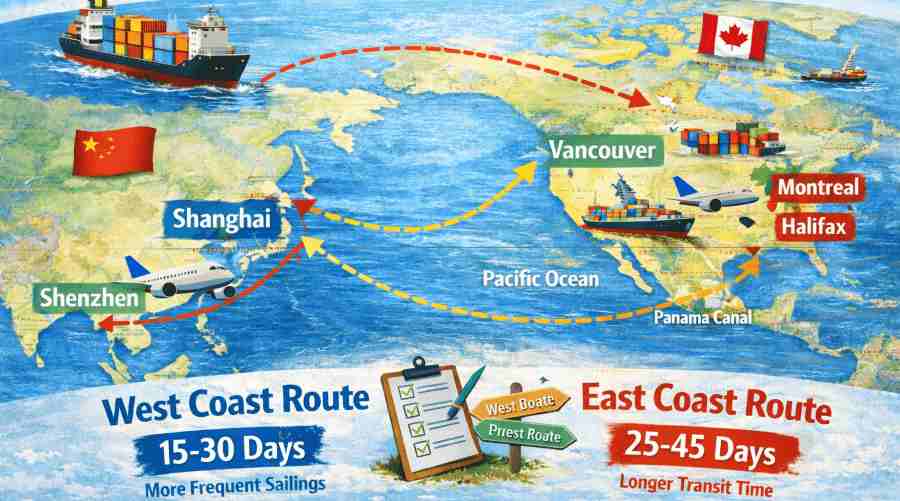
So, if your final delivery is on the West Coast, it makes sense to use the West Coast route. It reduces inland travel and generally means a cleaner delivery chain.
Goods in transit via the West Coast route generally take 12-25 days to arrive in Canada, while those via the East Coast route take 30-40 days.
But here’s the thing…
If your final delivery is to Toronto, Montreal, or any of the other major East Coast cities, the fastest ocean route may not be the fastest door-to-door route.
You’ve still got to get your cargo inland, after all.
Just because Vancouver might be a faster destination by sea, doesn’t mean it’s going to land on your doorstep that much faster.
There might be rail or truck legs that you need to factor in, depending on exactly where your cargo needs to end up.
The right route really depends on where you’re delivering to – not just where the ship happens to dock.
8. What Factors Affect China to Canada Shipping Time the Most?
Shipping time is affected more by handling, customs clearance, and inland delivery than by distance alone.
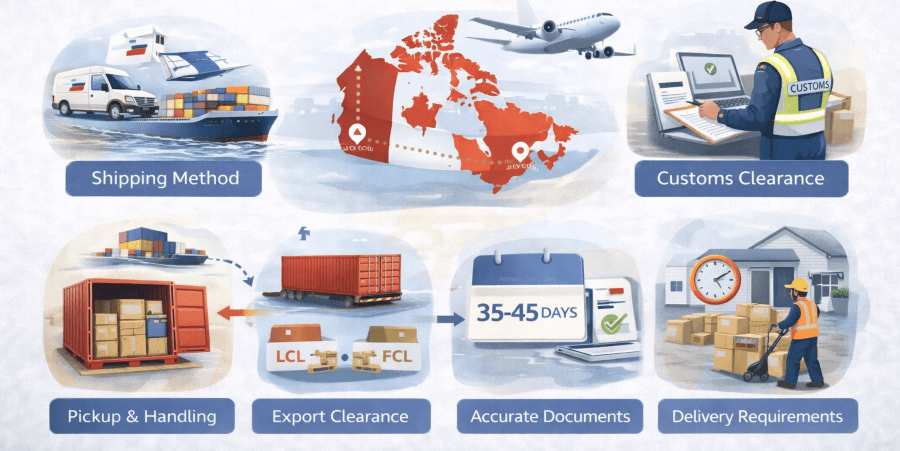
However, other factors include:
- The shipping method you choose (express air, or sea freight)
- How direct the route is
- Whether you’re doing LCL or FCL on sea freight
- How quickly customs can clear your shipment
- How accurate your documents are
- Where in Canada your cargo needs to go – and your delivery appointment requirements
Seasonal capacity and congestion can also play a role…
Some of these things you can’t control – weather, congestion, and all that.
But the biggest thing you can control? Making sure your shipment details and documents are spot on before you even send the thing.
9. What Causes the Biggest Delays When Shipping from China to Canada?
The biggest delays usually happen after arrival, mainly due to customs inspections, documentation issues, or inland transport bottlenecks.
Most delays are caused by the same old issues that keep popping up.
Missing cutoffs – the cargo isn’t ready when it’s supposed to be.
Mistakes with the documents…
The invoice doesn’t match the packing list…
The HS code is all wrong…
Customs has questions…
The routing changes at the last minute…
And sometimes, capacity just gets too tight, and a shipment gets rolled.
Then there’s the reality of last-mile delivery – getting your cargo from the warehouse to the doorstep can take days, thanks to delivery appointments, warehouse receiving windows, and all that.
If you want to avoid surprises, just build a little buffer time into your plan – especially if you’re doing a big product launch or Amazon replenishment.
10. How Does Peak Season Change Shipping Times?
Peak season can significantly extend shipping time from China to Canada, especially for sea freight and LCL shipments.
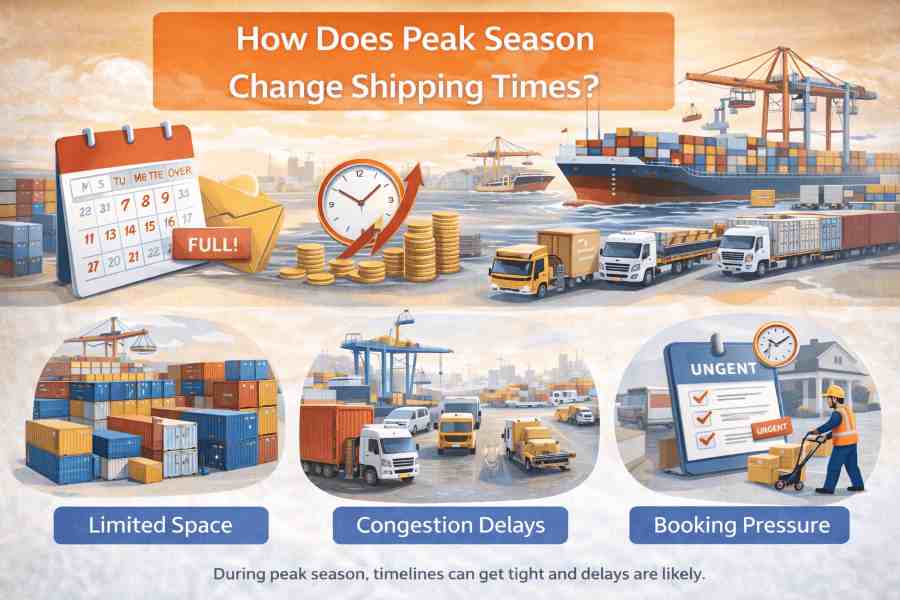
Peak season brings a whole new level of chaos.
Prices aren’t the only thing that goes up.
Time becomes tighter.
Shipments get booked up fast – space fills quickly.
Schedules get jam-packed.
Rollovers (those inevitable last-minute re-bookings) become way more common.
Shipping containers and trucks become more difficult to book as demand peaks
And on top of all that, ports and terminals are absolute madhouses.
During peak season, timelines can get pretty wonky.
You need to be prepared for some serious variability.
If you’re shipping during a busy period, the best thing to do is just keep it simple.
Book your shipment as early as possible – for air freight, do it 2-3 weeks before, and 30-45 days in advance for sea freight
Double-check the cutoff dates to make sure you’re not missing a window.
Get A Timeline You Can Plan Around
If you want a realistic shipping timeline from China to Canada, don’t just make wild guesses.
Get down to business with the nitty-gritty details.
Start by sharing the pickup city in China, the destination city in Canada, the delivery type, and the cargo you’re shipping.
As Winsky Freight, we’ve been handling international shipments since 2007, and we can create a realistic timeline based on your exact cargo, route, and delivery scope.
Get a quote and a timeline you can plan around.