7 Active Shipping Routes from China: Guide to Routes, Transit Times & Ports
EmmayipWF
October 31, 2026
There are seven active shipping routes from China. But not all of them are right for you. Depending on the goods you’re importing, one route might be a time-saver; another can be a disaster, costing you a fortune.
This guide covers all information about the accurate, current maritime pathways and transit times, so you can bypass all choke points.
Key Takeaways
- Red Sea disruptions now add 10–14 days, causing elevated ocean freight rates.
- The “Ice Silk Road” route decreases China-to-Europe transit times by up to 20 days.
- Shipping routes from China to the USA West Coast are still the fastest maritime option (taking 11-15 days via Matson Express).
- The right Port of Loading (POL) can reduce your inland logistics costs significantly. Ex: Shenzhen for electronics, Ningbo for textiles, etc.
5 Major Origin Ports in China
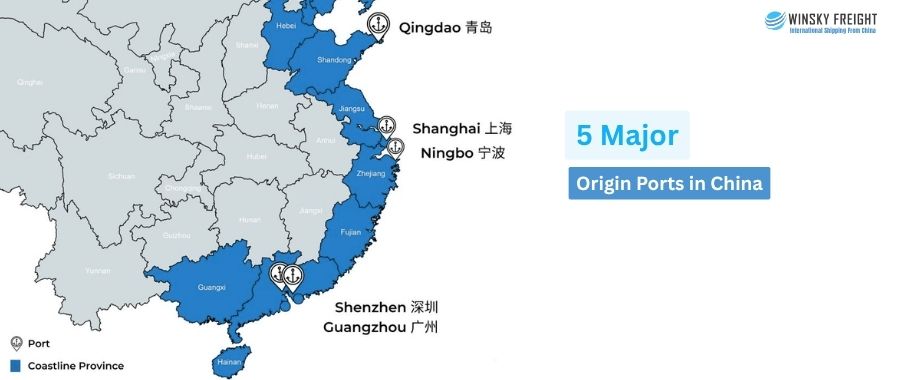
Choosing the right shipping routes from China starts with picking the right port. And it’s not like selecting the closest port to your supplier’s factory is always the right way.
You should opt for the POL (port of loading) considering the port congestion status, carrier schedules, and the particular shipping routes from China to the USA, Europe, or anywhere you intend to go.
There are “BIG 5” major ports in China. Such as;
1. Port of Shanghai
Considered the busiest port in the world, Shanghai is your primary gateway for the Yangtze River Delta.
For handling general cargo, industrial machinery, and bulk goods, the Port of Shanghai is the most preferred one.
2. Port of Shenzhen (Yantian & Shekou)
Shenzhen is the hub of tech and electronic items globally. It offers the fastest route to the Trans-Pacific Ocean through which your goods will be imported. More specifically, the Yantian terminal is the most commonly used port for express e-commerce shipments.
So, if you source smart products like gadgets, PCB boards, and consumer electronics, you’re most likely to import through this port.
3. Port of Ningbo-Zhoushan
For importing heavy machinery, automobile parts, and textiles from Zhejiang province, it’s the go-to favorite port for many importers. Now, it’s also the primary launchpad for the new Arctic route to Europe.
Many importers prefer this port when the Port of Shanghai encounters extreme congestion.
4. Port of Guangzhou (Nansha)
Guangzhou is the hub for manufacturing apparel, toys, and furniture. Besides, Nansha Terminal features very good LCL (Less than Container Load) consolidation services. Therefore, it’s the perfect hub if you’re importing small consignments.
5. Qingdao Port
Qingdao port is the most efficient launch pad for importing agricultural goods, industrial equipment, tires, raw materials. etc. from the northern side of China.
7 Primary Shipping Routes from China (By Destination)
Segmented into three primary categories, there are a total of 7 major shipping routes from China to anywhere in the world.
Trans-Pacific Routes (To North & South America)
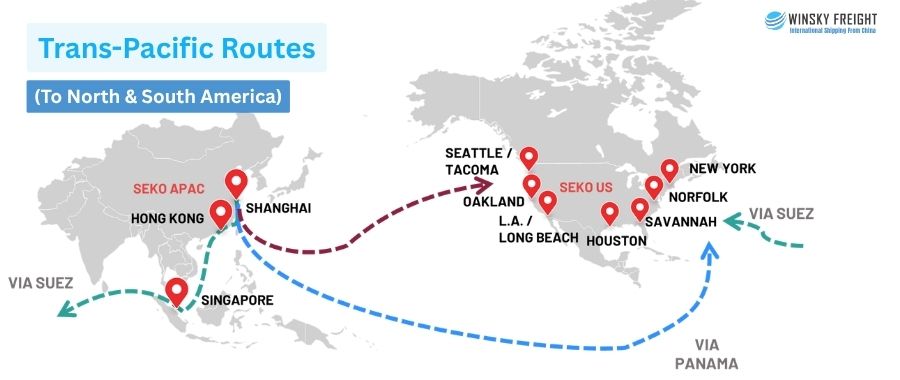
We get most queries about shipping routes from China regarding the Trans-Pacific Eastbound (TPEB) trade lanes. Though there’s ongoing geopolitical tension, you can still ship from China to the USA via these routes.
Route 1: TPEB West Coast (Standard Ocean)
It’s the major workhorse of the Pacific Ocean. When your shipment departs from Shanghai, Ningbo, and Shenzhen heading to any prime West Coast terminals such as Port of Los Angeles, Long Beach, or Seattle.
The typical transit time ranges from 14 to 20 days through this route. If you’re dealing with B2B cargo (where cost matters more than freight speed), this is the best route for you.
Route 2: TPEB West Coast (Express/ Matson)
This route is widely used by high-margin business owners, Amazon FBA sellers and importers. Why?
Because some specialized carriers (ex, Matson) offer fast-boat service to allow you to avoid common congestion.
Usually, these express routes take around 11 to 12 days, considering the port-to-port destination.
So, if you’re looking for a fast route and don’t have any budget issues, go for this route.
Route 3: East Coast Routing (Via Panama)
An important yet somewhat unpredictable shipping route from China to the USA East Coast. In general, Chinese cargo vessels would cross the Pacific and sail through the Panama Canal when the destinations are New York, Savannah, or Charleston.
However, recently, due to the fluctuating water levels, many ships have to anchor and get stuck in Panama for a while.
Therefore, many importers have switched to the West Coast, utilizing inland rail (IPL) for East Coast destinations.
Asia-Europe Routes (Navigating Chokepoints vs. The Arctic Route)
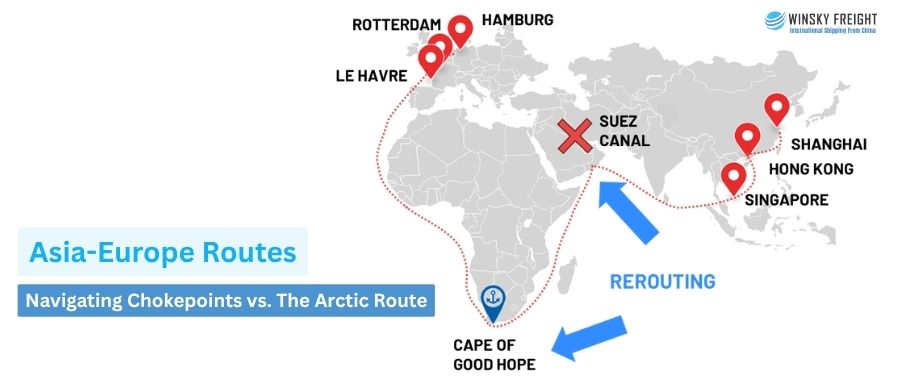
The international shipping routes from China to Europe have shifted significantly in recent years. Unlike in the past, you now have to choose between traditional endurance and modern maritime innovation. Check out why;
Route 4: Asia Europe via the Cape of Good Hope
Once it was the most popular direct path from China to Europe was through the Strait of Malacca, across India Ocean, up through the Red Sea and the Suez Canal.
But things have changed these days!
After the 2026 geopolitical conflicts in the Red Sea and Bab el-Mandeb Strait, many ocean carriers have abandoned this route. Among them are big players such as MSC, Maersk, Hapag-Lloyd.
Currently, carriers prefer to travel via the eastern coast of Africa and around the Cape of Good Hope as their primary route.
However, this strategic detour adds an extra 3000+ nautical miles, which results in an increased transit time of 10 to 14 days. It also caused an increase in the freight costs.
Route 5: Ice Silk Road
Because of the disruptions in the Suez Canal route, importers now regularly use the Arctic Ocean route. The shipping route is mostly active during the summer to the early autumn months.
You can witness special ice-class vessels that depart from Ningbo and sail north along the Russian coast through the Arctic.
The good thing is that this particular route cuts the transit time to Northern Europe by 40% compared to the traditional Cape of Good Hope route. Hence, you can save up to 20 days by following this route.
Intra-Asia & Overland Express Routes
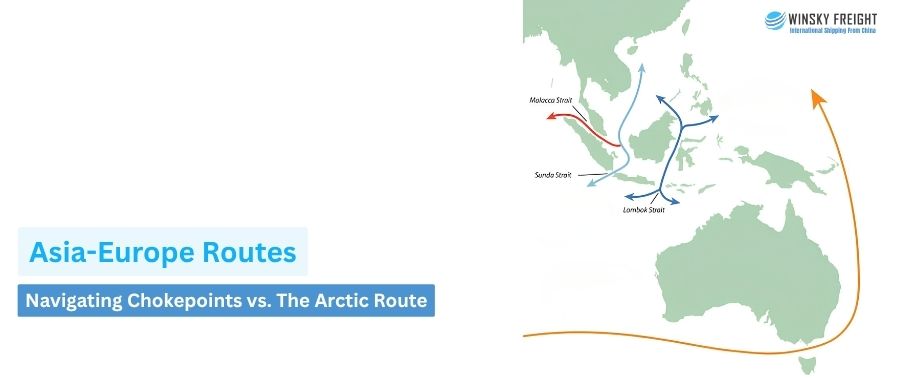
These are the major shipping routes in Southeast Asia, acting as the stepping stones to the rest of the world.
Route 6: Intra-Asia & Emerging Markets
The Strait of Malacca is one of the most critical chokepoints in the world. It controls a massive volume of Intra-Asia trade. Chinese factories supply Malaysia, Thailand, and Vietnam, following this route. It’s also the primary departure route for shipments heading toward Latin America and Africa (through Mombasa/Durban). This way, you can avoid the bottlenecks of the traditional Northern Hemisphere.
Route 7: China-Europe Railway Express
Recently, this route also became very popular in China to other countries’ supply chain scenarios. Although it’s not a sea route, the Belt and Road land rail networks are a great middle option.
In brief, your cargo will depart from the Chinese hubs like Xi’an or Chengdu. Then it’ll be passing through Kazakhstan and Russia, ultimately arriving in Europe (Warsaw, Duisburg, Germany, Poland).
The transit time can take up to 15 to 18 days. This one also takes less time than the Cape of Good Hope route and is cheaper as well.
2026 Transit Time Comparison by Destination (Data Table)
Below you can find real-world data about the port-to-port transit times from China to the different regions of the world. Please note, these are the estimates based on recent years’ data (excluding customs clearance and inland tracking time to the final destination)
| Port of Loading (POL) | Port of Discharge (POD) | Route Category | 2026 Est. Transit Time (Days) |
| Shanghai, China | Los Angeles, USA | Trans-Pacific West (Standard) | 14 – 18 Days |
| Shanghai, China | Los Angeles, USA | Trans-Pacific West (Matson Express) | 11 – 12 Days |
| Shenzhen, China | New York, USA | Trans-Pacific East (via Panama) | 32 – 40 Days |
| Ningbo, China | Rotterdam, Europe | Asia-Europe (via Cape) | 38 – 46 Days |
| Ningbo, China | Northern Europe | Asia-Europe (via Arctic) | 18 – 22 Days (Summer only) |
| Qingdao, China | Felixstowe, UK | Asia-Europe (via Cape) | 40 – 48 Days |
Air, Sea or Rail: Choosing the Right Mode for Your Cargo
Only utilizing the right shipping from China isn’t enough. You also need to select the right shipping methods to the USA, Europe, and the rest of the world.
Basically, you’ve got 3 primary shipping methods to choose from:
Air Freight
If your business requires the fastest shipping, then air freight is undisputed. Usually, it can take around 3 to 7 days to ship globally from China.
However, the trade-off is that the cost can be 5x to 10x compared to the ocean freight shipping method.
Air freight shipping method is mostly preferable if you require high-value and time-sensitive goods and can ensure a high margin from your selling items (ex, fashion items, latest tech and electronics).
Sea Freight
It’s needless to say that global trade from China is highly dependent on the ocean freight shipping method, transporting 80% of all imported goods. It’s mainly because of the economic nature and capability of handling high volume items.
Furthermore, you can choose between LCL and FCL shipping options. FCL (Full Container Load) allows you to book a 20ft or 40ft container. So, there’s low handling risk.
On the other hand, LCL (Less than Container Load) enables you to share a container with others, cutting the shipping costs while importing small consignments.
Rail Express
As discussed above, the China-to-Europe rail network is a hybrid if you need faster turnarounds than the Cape-diverted route. The cost is lower than air freight from China.
Hidden Bottlenecks: What Causes Delays on China Shipping Routes?
Even if you choose the best shipping route from China, that can be highly problematic if you ignore the real-world port problems. And that’s a common mistake importers make.
Port problems are also major reasons causing shipping delays in China, which can cause hard loss.
- Problem 1: Blank Sailing and Rolled Cargo – Ocean alliances control the vessel capacity. They do it to maintain a high freight rate. For example, they can abruptly cancel a scheduled voyage (blank sailing) if demand drops. And in the worst case, if your cargo ship is overbooked, your container might get bumped to the next week’s vessel.
- Problem 2: Geopolitical and Canal Constraints – Global chokepoints can sometimes cause serious issues. Take the Red Sea crisis or the Panama Canal droughts as an example. Therefore, you can’t always fix your route. According to the Lloyd’s List, reliance on single trade corridors has become a massive risk for importers. You’ve to adapt flexible routing strategies.
- Problem 3: Seasonal Surges – Shipment costs from China can skyrocket during Chinese New Year (January/Fabruary), the Golden Week holiday (October), and the Quarter 3 Peak Season crunch (August-October). You’ll also encounter a container shortage during this time.
- Problem 4: Customs Clearance and Incoterms – After overcoming all the situations, you can still expect delays if there are any customs complications. Your shipment might arrive on time at the port, but if it’s missing any paperwork, your cargo will be held for weeks. Even worse, this can lead to unexpected demurrage and detention fees at your destination port.
How Does a Strategic Freight Forwarder Optimize Your Routing?
Despite such unstable supply chain logistics issues, China is still a hub of opportunities for business owners. Just don’t solely rely on your Chinese suppliers or factory to arrange the shipment.
Instead, get up with an NVOCC (Non-Vessel Operating Common Carrier) or a dedicated logistics partner.
They know the best shipping routes from China to anywhere in the world, the current situations in the ports, customs formalities, and everything to ship your goods safely to your doorstep.
At Winsky Freight, we do this every day for our hundreds of B2B and e-commerce businesses operating globally. Reach out to us for your next shipment.