
6000+
Cooperating customers
100+
Countries we ship
2000+
orders fulfilled each week
10+
years of experience
The Ultimate Guide to Shipping Cost from China: Rates, Times, and Hidden Fees
The shipping cost from China just got some drastic changes due to the changes in carrier capacities, ongoing Red Sea vessel diversions, new USTR tariff announcement. Nonetheless, there’s also an impact of early Peak Season Surcharges (PSS).
This guide will help you identify the current freight costs from China and how to control them.
Quick Summary: How Much Does Shipping from China Cost?
The international shipping cost from China differs depending on the shipping method you choose (air, sea, express), your destination country, dimensional volume, and gross weight of the cargo.
As always, sea freight is still the most cost-effective method for bulk shipment. And for urgent delivery, air and express freight shipping services remain the priority.
Average Direct Baseline Cost Comparison
| Shipping Methods | Shipping Rates | Transit Times |
|---|---|---|
| Express Courier (DHL/UPS/FedEx) | $6.50 – $9.50 per kg | 3 – 7 days |
| Air Freight from China | $4.20 – $7.00 per kg (standard cargo) | 5 – 10 days |
| Sea Freight LCL | $80 – $150 per CBM | 20 – 40 days |
| Sea Freight FCL (20ft container to US West Coast) | $2,100 – $3,100 | 14 – 22 days |
Warning: These are only the China and the line-haul sea and air freight charges. There will be additional costs such as destination terminal charges, customs duties, inland drayage, etc.
Shipping Methods & Average Global Freight Rates From China
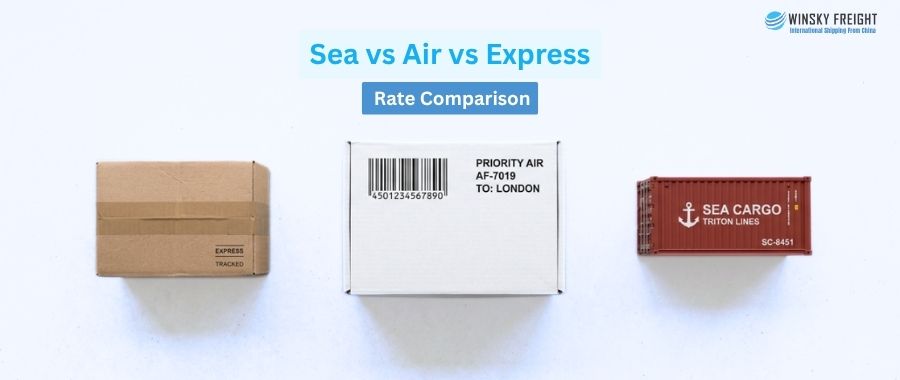
You can find a detailed overview of the different shipping methods below.
1. International Express Courier Rates From China (DHL, UPS, FedEx)
If your products feature high margins and you need them urgently, express courier is still the gold standard for shipment weights ranging from 30 kg to 50 kg or less.
- Current Cost:Between $6.50 and $9.50 per kg to major western countries (EU, US)
- Transit Time:3-7 business days
- Best For: High-priced prototypes/samples, urgent inventory restocking, D2C premium consumer goods.
- Cons:Shipping via express courier companies like DHL can decimate your profit margins easily. Sometimes, they enforce aggressive penalties for dimensional weight.
Check out Winsky Freight’s express shipping guide for a detailed guideline on optimizing small parcel networks.
2. Air Freight Rates From China
Next, the standard air freight from China works as a better alternative to express courier if your products weigh 50 kg+ to 500 kg.
You need a dedicated freight forwarder to pick up your cargo from the Chinese supplier, move it from the origin to the destination airport, and manage the destination customs clearance.
Unlike express freight, air freight pricing has a weight bracket. So, it’s like the heavier your cargo weight is, the lower your base rate per kg becomes.
Air Freight Rate From China To USA/EU In 2026
| Weight | Expected Freight Rate (USD/kg) | Note For Importers |
|---|---|---|
| 45 kg – 100 kg | $8.0 – $10.0 | Minimum entry point for commercial air freight. |
| 100 kg – 300 kg | $6.0 – $8.0 | Most used tier for urgent Amazon FBA restock. |
| 300 kg – 500 kg | $5.5 – $7.5 | Mid-volume pricing range. |
| Over 500 kg | $5.0 – $6.0 | Maximum volume discount rate for heavy air cargo. |
Note: These pricing brackets are subject to change/fluctuate every week depending on the aviation fuel adjustments and capacity. For an accurate rate, ask for a live quote from your freight forwarder.
3. Sea Freight Rates From China
Most commercial importers rely heavily on sea freight from China due to its economic value. If you’re importing 2-3 CBM (Cubic Meters), ocean freight is the most financially viable lifeline for you.
LCL vs FCL Shipping: What’s The Difference?
All sea freight is categorized into two segments, LCL and FCL.
- LCL (Less Than Container Load): Your shipment shares the cargo space with other importers, paying only for the physical space your items occupy. It’s billed based on per CBM. It’s preferable for shipment volume anywhere from 2 CBM to 14 CBM.
- FCL (Full Container Load):As the name suggests, you pay a flat rate for an entire container regardless of the payload optimization. If your shipment volume is beyond 14 CBM, FCL becomes a financially better alternative to LCL.
Tipping Point: The LCL shipping method requires a deconsolidation fee, as you need labor support to unpack the shared boxes. Check out more on LCL vs FCL shipping methods.
Container Shipping Costs: 20ft vs. 40ft
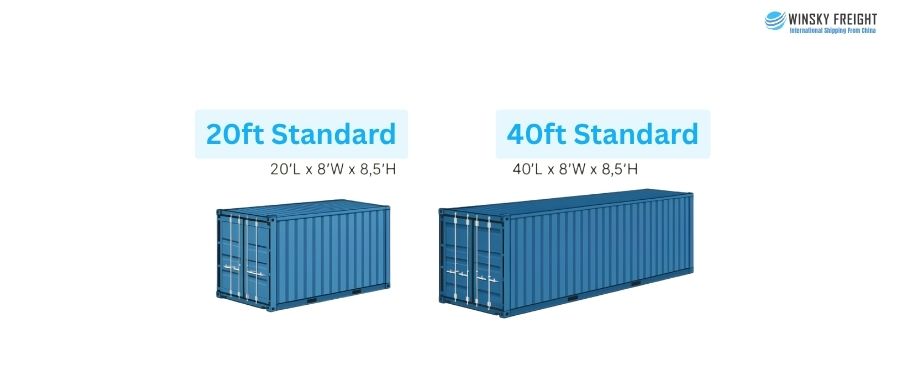
The container shipping cost from Chinese major ports like Shanghai, Shenzhen, and Ningbo has been elevated because of the recent vessel diversions and mid-2026 Peak Season Surcharges (PSS).
Baseline Port-to-Port Sea Freight Rates In 2026
| Type of Container | Maximum Payload Profile | China to the US West Coast | China to the US East Coast |
|---|---|---|---|
| 20ft Standard | ~28 CBM / 21,700 kg | $2,100 – $3,100 | $2,500 – $3,500 |
| 40ft Standard | ~58 CBM / 26,500 kg | $3,400 – $4,600 | $4,100 – $5,200 |
| 40ft High Cube | ~68 CBM / 26,500 kg | $3,600 – $4,800 | $4,500 – $5,500 |
Note: There will be additional charges like customs bonds, terminal handling, and inland dryage. Consider evaluating the final rate afterward.
Deep Dive: Shipping Cost From China To The USA
China to the USA transpacific trading leads the highest international shipment globally. To mitigate the East Coast capacity constraints, you need to understand the routing strategy precisely.
Shipping From China To USA By Air vs. Sea
Air freight shipping method is your emergency failsafe if a stock replenishment is urgent. Choose sea freight shipping for feasible inventory scaling.
- Air Freight Shipping Cost from China to USA (per KG): The expected charge is between $4.50 and $6.50 per kg, depending on routing to the West Coast hub (LAX) versus the East Coast hub (JFK)
- Sea Freight Shipping Cost from China to USA (Container-wise): For a 40ft container routing to Los Angeles, sea freight can cost around $3,800. The same container costs around $5,000 if designated to New York or Savannah.
Shipping From China To USA Time
The shipping time from China can vary widely depending on the different shipping methods.
| Routing Examples | Expected Sea Transit Time | Expected Air Transit Time |
|---|---|---|
| China to the US West Coast (LA/Long Beach) | 14 – 22 Days | 5 – 8 Days |
| China to the US East Coast (NY/Savannah) | 28 – 38 Days | 7 – 10 Days |
| China to the US Midwest | 22 – 30 Days | 7 – 10 Days |
Note: The following expected transit duration includes only the air flight and vessel movement. It’s wise to consider another 7-12 days buffer for consolidation in China, customs proceedings, and destination chassis shortages.
Understanding Weight: Chargeable Volumetric Weight vs. Gross Weight
Most new importers get confused between Chargeable volumetric weight and Gross weight. Aircraft can run out of physical space fast if booked with lightweight yet bulky items such as mattresses/pillows.
Therefore, airlines consider the accurate gross weight against the volumetric or dimensional weight. Whichever is higher, that’ll be your bill.
Air Freight Volumetric Formula:
Volumetric Weight (kg) = (Length cm × Width cm × Height cm) ÷ 6,000
Example: Consider you’re shipping a plastic toy pallet. So,
- Actual Gross Weight:120kg
- Dimensions:120 cm × 100 cm × 150 cm
- Calculation:120 × 100 × 150 = 1,800,000 cm3
- Volumetric Result: 1,800,000 / 6,000 = 300 kg
That means, even though your product’s gross weight is 120 kg, you’ve to pay for 300 kg of chargeable volumetric weight.
Incoterms & Strategy: Door to Door vs. Port to Port Shipping
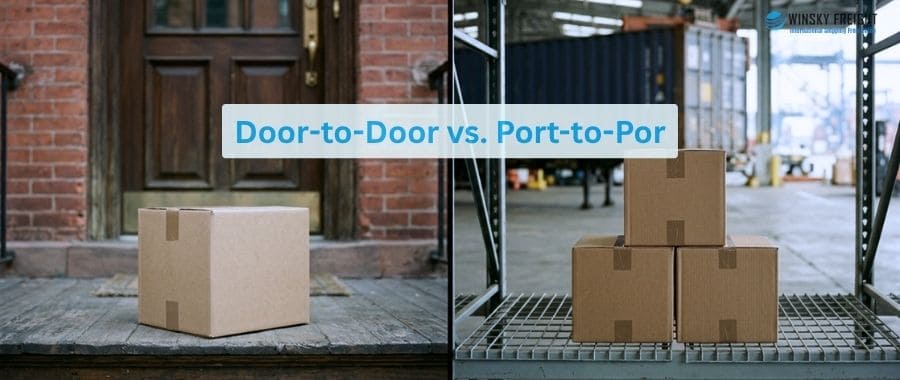
Incoterms are the regulations to maintain a fair international trading experience. These dictate the risk between the buyer (you) and the Chinese supplier. Incoterms don’t directly influence the shipping cost from China.
What makes the difference in rates is whether you’re choosing a port-to-port vs. door-to-door shipping method.
There are mainly two common Incoterms you may encounter as a beginner importer–EXW and FOB.
EXW (Ex Works) Factory Pricing vs. FOB (Free on Board) Shipping Cost
EXW (Ex Works) Factory Price:
In this term, your supplier is only responsible for manufacturing the products you order. You, as a buyer, have to handle the rest of the operations, such as origin trucking, export customs clearance, sea freight management, and import customs proceedings.
On Chinese B2B platforms, it may look cheap, but it can later saddle you with high logistical risk.
FOB (Free On Board) Price:
On the contrary, FOB ensures that your Chinese supplier takes care of the origin trucking (from the factory to the port) and export customs formalities. You’re only liable to handle the processes and fees afterward.
What Is DDP Shipping & Does It Include All Costs?
If you still have concerns, Incoterms DDP is your best solution. DDP is a trading mitigation strategy, especially for Amazon FBA sellers and SMBs, where your hired freight forwarder handles the entire logistics process.
This package includes all costs, including:
- Inland trucking costs in China
- Chinese export clearance costs
- Sea or air freight cost
- Customs clearance costs in the destination/your country
- Import duties and taxes
- Last-mile delivery from the import country port to your warehouse or doorstep
Hidden Fee Traps In Port-To-Port Sea Freight Shipping From China
Shipping from China is filled with pitfalls of hidden destination charges at every step. The dream of building an import business can instantly turn into a nightmare if you don’t consult a seasoned freight forwarding partner. Always be aware of the following lethal destination charges:
ISF Filing Penalties (For The United States): You or the freight forwarder needs to submit an Importer Security Filing 24 hours in advance of loading your cargo in the Chinese port. Failing to do so can result in a $5000 fine by the US Customs.
Terminal Handling Charges: These are mandatory fees applied by the port authority to crane your cargo off the vessel to the container holding area.
De-Consolidation Fees (LCL): Laborers work to reorganize a shared container charge a fee too.
Demurrage & Detention: You’ve to pay a penalty fee on a daily basis if your imported items stay at the port more than the allocated free time. It appears due to a customs hold or chassis shortage.
Inland Drayage: The domestic trucking cost to move your products from the port to your warehouse or doorstep can easily cost $400 to $1,200.
Customs, Duties, and Taxes When Shipping From China
Without the above, there are significant costs related to the government border fees. Such as;
- HS Codes & Import Duties: The Harmonized System code influences your duty rate, which can be anywhere from 0% to 20%.
- The June 2026 USTR Updates: There’s a newly proposed 10% to 12.5% tariff by USTR in June 2026 (on some investigations). This means that soon there would be a surcharge cost on top of the existing Section 301 tariffs.
- VAT (UK/Europe): VAT is calculated by summing up the value of the products, freight costs, duty. It can range 19% to 22%.
Three Reasons Shipping From China Is So Expensive In 2026
If you recently asked for a quote from any freight forwarder, you’re supposed to receive an extremely elevated rate. Because right now, the core cost drivers include:
- Early Peak Season Surcharges (PSS): Maersk, MSC, and other major sea alliances have already imposed aggressive surcharges due to the early peak season arrival. It results in higher shipping rates from China.
- Red Sea Vessel Diversions: The Middle East geopolitical situation has caused Chinese vessels to drive through the Cape of Good Hope, which causes 10-14 days of delays in transit time. The more time on a running vessel means the more amount of fuel is burned, so your shipping rates are getting higher.
- Blank Sailings: Often, some carriers manipulate rates intentionally to cancel scheduled sailings. This helps them keep spaces tight. However, importers encounter higher shipping charges.
Actionable Advice: How To Reduce Shipping Costs From China
The straight answer is with Experience and Strategies! It’s not possible to eliminate the global geopolitical heat in a day. Instead, what you can do is engineer your logistics profile in order to defend your profit.
How Do Small Businesses Find Cheap Freight Shipping From China?
Don’t make common mistakes like small businesses do. Never rely blindly on Alibaba’s shipping fee estimator. It doesn’t include destination port charges.
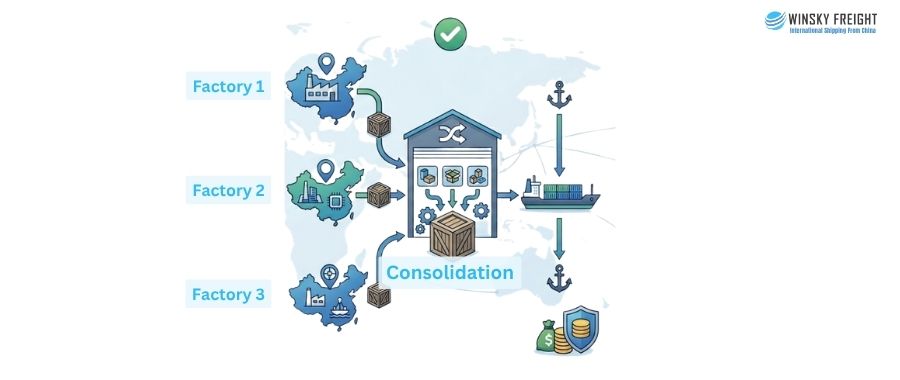
Smart small businesses embrace the consolidation strategy to reduce their freight shipping cost from China. It’s a logical and practical approach.
So, it works as if you order 3 items from 3 Chinese regions (eg, Guangdong, Shenzhen, etc.), you don’t book 3 separate LCL shipments.
Instead, work with a dedicated Chinese freight forawarder, they can help you collect those goods from 3 different locations first. Then they will manually unpack and merge them into a single package.
Therefore, when you ship them as an one shipment, you only pay for the single unit shipping cost, not for 3 units.
Final Verdict
Often, some new importers use basic online calculators or outdated information to estimate the shipping cost from China. They can’t provide you with the right answer. If you blindly tie with a port-to-port quote, soon your profit margin will bleed when actual costs and penalties show up with the shipment at your destination airport.
Don’t risk a moment trying the wrong way. Contact Winsky freight for your free shipping quote today.