Shipping Cost from China to Australia: Complete Cost & Shipping Options
Editor-User
October 21, 2026
Cheap sea freight rates often lead to higher final bills for Australian importers due to infamous destination port charges.
For instance, sometimes a $50 quote/cubic meter can cost you $400 once the goods land in Melbourne or Sydney.
That’s why, for importers like you, understanding reallife structure of the shipping cost from China to Australia is critical.
Winsky Freight successfully handled more than 8,600 shipments from China for our Australian importers. We know the data, latest customs rules.
So, we created this deep guide with all the shipping costs you’ll encounter, including taxes and hidden fees.
Whether your shipment plan is a small carton or a 40ft container, this is the guide for your shipping from China to Australia. Let’s head into it.
Table of Contents
| Section | Key Findings |
|---|---|
| 1. What Determines Shipping Cost? | Costs are driven by “Chargeable Weight” and seasonality. “Green Logistics” has added low-sulphur fuel surcharges that fluctuate monthly. |
| 2. Shipping Cost by Method | Express is best for <150kg; Sea FCL becomes more economical than LCL once volume exceeds 15 CBM due to lower per-unit destination fees. |
| 3. Ocean Freight Cost | FCL 20ft containers average $1,250–$2,200, while LCL rates look cheap ($50-$150/CBM) but carry high “landing” charges. |
| 4. Air Freight Cost | Rates sit between $3.80–$8.00/kg. Costs drop for shipments over 1,000kg, making it a viable “emergency” option for high-value inventory. |
| 5. Express Shipping Cost | DHL/FedEx offer all-inclusive transit (3–5 days). While base rates are $6–$14/kg, remember that GST and Duties are billed separately. |
| 6. China to Australia Cost Breakdown | Estimation of Origin fees (China), International Freight, and Australian Destination charges. |
| 7. How Incoterms Affect Cost | FOB is highly recommended to avoid the “CIF Trap.” Suppliers use cheap agents, causing inflated local Australian fees. |
| 8. Import Tax, Duty & GST | Most commercial goods over AUD $1,000 trigger 10% GST and an IPC fee (up to $192). |
| 9. How to Reduce Shipping Costs | Combine multiple supplier orders into one shipment. |
What Determines Shipping Cost from China to Australia?
China to Australia shipping costs are dynamic. There are four main factors that impact your final cost:
- Weight vs. Volume: Carriers’ cost depends on the “Chargeable Weight.” That means, if you ship cotton (lightweight but spreads), you’ve to pay for the space. And if you ship stainless steel (heavy but small), you’ve to pay for the goods’ weight.
- Shipping Distance: Southern ports in China (Shenzhen) are closer to Australia compared to Northern China (Qingdao). Therefore, the South Chinese region costs lower rates and faster transit.
- Seasonality: Before the Chinese New Year (January-February) and during the peak season (August-October), the shipping costs from China to Australia can double due to demand surcharges (PSS).
- Fuel Surcharges: After the green logistics push, carriers now use low-sulphur surcharges. And that fluctuates every month, affecting the actual costs.
Shipping Cost by Shipping Method (Comparison Table)
Due to those variables, choosing the shipping methods becomes a big lever to control the import costs.
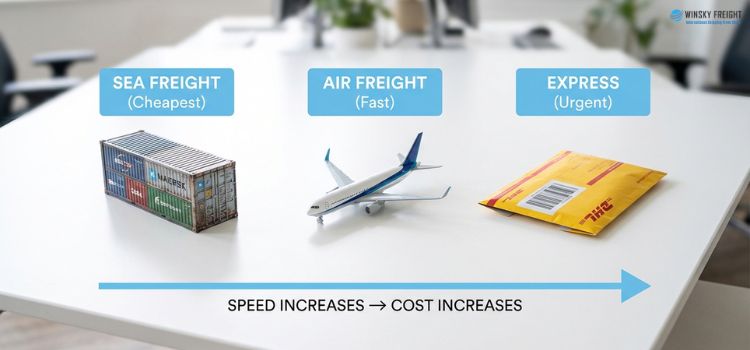
Cost Comparison Table (Estimates for 2026)
| Feature | Ocean Freight (LCL) | Ocean Freight (FCL) | Air Freight | Express (DHL/FedEx) |
|---|---|---|---|---|
| Cost Profile | Low Freight / High Destination Fees | Flat Rate / Most Economical | High / Variable | Premium / All-Inclusive |
| Best Weight | 1 CBM to 15 CBM | 15 CBM+ (or less than 10 tons) | 150kg to 500kg | Less than 150kg |
| Typical Rate | $50 to $150 per CBM | $1,500 to $3,200 per Container | $4.50 to $8.00 per KG | $6.00 to $10.00 per KG |
| Hidden Costs | Deconsolidation Charges | Port Service Fees | Trucking or Fuel Costs | Fuel Surcharge (Index) |
| Transit Time | 20 to 30 Days | 15 to 25 Days | 5 to 10 Days | 3 to 5 Days |
1. Ocean Freight Cost from China to Australia
Sea freight has always been the backbone of global trade. The same in terms of shipping from China to Australia as well.
FCL (Full Container Load)
In this method, you rent a full 20ft or 40ft container and pay a flat rate for it. The 20-foot container shipping cost from China to Australia is usually $1,500-$2,200, depending on the season.
The cost of shipping a 40ft container can offer you a better value per cubic meter if you’re shipping more volume. Expect anything between $2,800 and $3,500.
LCL (Less than Container Load)
Instead of renting a whole container, you pay per Cubic Meter (CBM) used for carrying your goods. That’s how LCL works.
Although the ocean rate looks cheap (sometimes as low as $10/CBM), due to the high destination charges in Australia (eg, Port Service Charge), your cost can go up to $50-$150 per CBM
Tip: If you need more than 13-15 CBM, book a whole 20ft container (FCL). It’s often cheaper than the LCL.
Calculation Tip: For shipments over 15 CBM, LCL fees will likely be more than the cost of a full container. Ask for an FCL quote comparison to see how much you could save by switching to a full private container.
2. Air Freight Cost from China to Australia
Air freight is priced per kilogram. So, you’ve to be very strategic. Always remember, your shipping rate (per kg) drops as your total goods’ weight increases.
For example, the rate/per kg for +1000kg is significantly cheaper than the rate/per kg for +100kg cargo.
The average air freight from China to Australia price for general cargo in 2026 sits around $4.50 – $8.00 USD/kg.
Hence, most importers in a hurry usually go for the Air Freight method. If you’re importing urgent fashion items or apparel, high-end electronics, it’s ideal (if speed justifies the premium price).
Hidden Cost: You’ve to bear the airport customs clearance charges and local trucking costs.
3. Express Shipping Cost (DHL, UPS, FedEx)
Express shipping is a “door-to-door” service. Therefore, carriers usually provide you with a quoted price, including the air freight and delivery to your door. Check out the table for typical costs for the major carriers:
Note: The below rates don’t include your Australian GST or Duties. You’ll get the bill from your courier before doorstep delivery.
Express Carrier Comparison (2026 Estimates)
| Carrier | Avg. Rate (Small Parcel < 21kg) | Avg. Rate (Heavy > 21kg) | Best For | Transit Time |
|---|---|---|---|---|
| DHL Express | $10 to $14 per kg | $7 to $11 per kg | Urgent documents & small parcels | 2 to 4 Days |
| FedEx IP | $9 to $13 per kg | $6 to $10 per kg | Fastest for heavy cargo (less than 100kg) | 3 to 5 Days |
| UPS Saver | $8 to $12 per kg | $6 to $9 per kg | Cost-effective for mid-range weight | 4 to 6 Days |
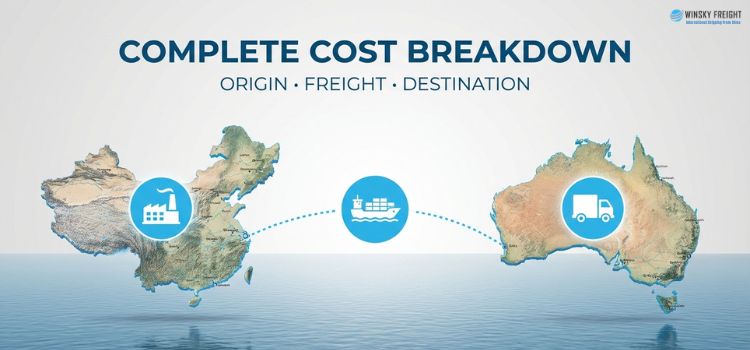
China to Australia Shipping Cost Breakdown
To avoid facing any surprise bills later, ensure you get a quote that’s split into three legs. Below you can find the estimated costs for importing from China to Australia in 2026:
1. Origin Charges (China):
- Pickup Charge from Your Factory (EXW): $100-$300 USD, depending on the distance and delivery truck size.
- Export Documentation and Customs: $75-$100 USD.
- Consolidation Warehousing: Free with Winsky Freight (typically, warehouse charge range is $2-$3/CBM/day).
2. International Freight:
- Air/Sea Rate: Check out the tables above.
- Fuel Surcharges (BAF/FSC): In general, it’s 10-20% of the base freight rate.
- Insurance:3% of your cargo value (Minimum $20-$30).
3. Destination Charges (Australia) – The “Hidden” Cost:
- Port Service Charges (PSC): $120-$150 AUD per CBM (for LCL) or $550 AUD per container (for FCL).
- Import Processing Charge (IPC): Australian Customs (ABF) charges this. The specific government fees can range from $50 to $192 AUD per shipment.
- Customs Brokerage: $150 – $250 AUD per entry.
- Terminal Handling & Delivery: At the final stage of the shipment, you’ve to take care of the cost of moving the goods from the ship to your door. And it’s quite expensive in Australia, ranging from $250 – $600+ AUD for metro delivery (changes based on volume).
Avoid Surprise Bills: Want to save yourself from calculating these complex fees? Go for a DDP (Delivered Duty Paid) quote. Winsky Freight handles all destination charges for one simple price. Get a DDP Quote Today.
How Incoterms Affect Shipping Cost (FOB vs CIF vs DDP)
Your choice of Incoterms 2020 determines what you pay and what your suppliers pay. There’s nothing like one sweet setting for all; decide based on your business cases and the supplier flexibility.
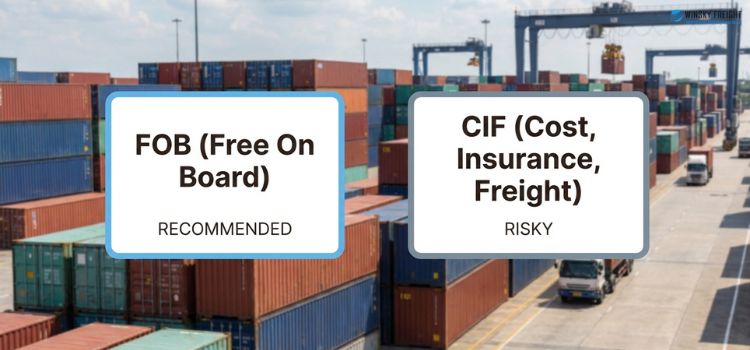
FOB (Free on Board): Recommended
You just pay for the freight and destination (Australian) charges. And your supplier has to bear all fees in China.
With this, you get full control over the shipping cost and Australian carrier choice.
CIF (Cost, Insurance, Freight): Risky
Your supplier pays for the freight to the Australian port.
But there’s a high chance that they use a cheap agent who charges you inflated destination fees, obviously to recover the cost!
Try to avoid CIF for the Less Than Container (LCL) method.
DDP (Delivered Duty Paid): Easiest
Winsky Freight or your forwarder gives you one “all-in” price that includes shipping, duties, trucking to your door.
So, you don’t have to worry and be relaxed from the complete shipping stress.
DDP shipping is ideal for small business owners and Amazon sellers.
Caution: If your current supplier quotes a surprisingly cheap CIF price, they are likely to hide the costs of Australian destination charges. Get that quote reviewed by us before you book.
How Much Of The Import Tax, Duty & GST In Australia
Without the above-mentioned, you’ve also have to pay some charges to the Australian government.
Note: GST is calculated on the Value of the Taxable Import (VoTI), not just based on the product price.
1. Import Duty:
- Standard Rate: 5% of the Free on Board (FOB) value.
- ChAFTA Benefit: Often reduced to 0% if having a valid Certificate of Origin under the China-Australia Free Trade Agreement.
2. GST (Goods and Services Tax):
- Rate: 10%.
- Formula: Your import GST is calculated on the CIF Value + Duty. (So, it’s equal to Value of Goods + Freight Cost + Insurance + Duty) x 10%. That means you should pay tax on the freight cost itself.
3. Import Processing Charge (IPC):
- The fixed charge to process your declaration (estimated: $50 – $192 AUD depending on value and shipping mode).
Tip: There’s an AUD $1,000 Threshold. If your shipment value is under AUD $1,000, generally you don’t require a formal Import Declaration and may be exempt from Duty and GST at the border.
However, Chinese suppliers or sellers may collect GST at the point of sale. Other than that, the above tax structure is applied to commercial shipments over this value.
Learn more about Import Taxes from China for a detailed idea.
How to Reduce Shipping Costs from China to Australia
Here’s where the expert freight forwarder magic comes from a decade of experience. With Winsky Freight, you can actually reduce significant shipping costs when importing from China to Australia. Check out how:
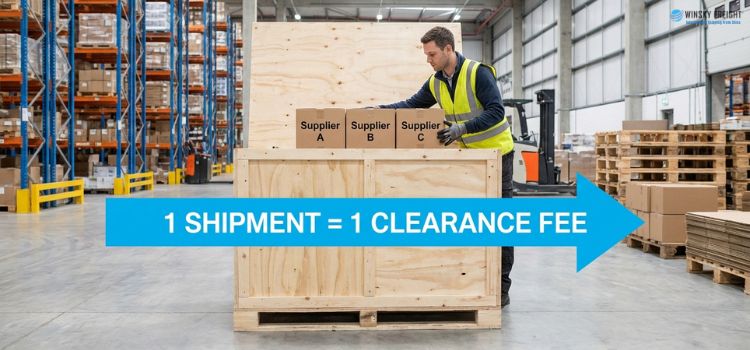
1. Consolidate Your Cargo
Follow this consolidation strategy when you buy from multiple suppliers (e.g., Yiwu Market). Why?
Because shipping 3 separate LCL loads will trigger 3 separate “Import Processing Charges” and “Port Fees.”
The good thing is Winsky’s freight consolidation combines them all into 1 shipment to save you hundreds of dollars in fixed fees.
2. Use ChAFTA
Always ask for a Certificate of Origin from your Chinese suppliers. It allows you to claim 0% duty.
3. Optimize Packaging:
Never leave with empty spaces, or at least reduce them. In terms of expensive shipping methods like air freight, even a small box can save a lot of money on volumetric weight.
4. Ship FOB:
Control your own freight to avoid the “CIF Destination Fee Trap.” Otherwise, you’ll be hit by high, surprise charges at the destination port.
5. Plan Around Peak Seasons
China has its own New Year fest. And shipping costs spike drastically during this rush (January) and the holiday peak (September-November).
Forecast your inventory requirements and book shipments 3-4 weeks in advance during these “shoulder” months.
This allows you to avoid Peak Season Surcharges (can add $500+ to the container’s cost).
Summary
It’s true that sea freight offers the most economical rate when importing bulk goods. But the high destination charges in Australian ports can catch beginners off guard.
For smaller shipments (eg, less than 150kg), air freight or express shipping often feels competitive once you factor in those fixed landing costs of sea freight.
Therefore, finding the cheapest shipping cost from China to Australia is more than just about the lowest freight rate. You need a sharp eye and a smart strategy to optimize other costs.
- With the right consolidation, you can minimize fixed fees
- Leverage the ChAFTA to eliminate duty
- Go for the right Incoterm (FOB) to maintain control
Winsky Freight has been tackling this for thousands of Australian importers since 2007. The best part–you always get transparent pricing.
Get a quick Freight quote or a full-fledged DDP solution with a full “Landed Cost” breakdown so you never face a surprise bill.
Frequently Asked Questions
1. Do I Need A Freight Forwarder To Ship from China To Australia?
Yes. A reliable freight forwarder isn’t your legal need, but rather an essential support. A forwarder books cargo space, tackles complex documentation, manages biosecurity clearance (DAFF), handles customs, and vice versa on your behalf. Otherwise, if doing it yourself would lead to costly delays and rejected cargo.
2. What Is The Cheapest Way To Ship From China To Australia?
It mostly depends on your product volume and shipping method. Sea Freight LCL method is the cheapest to ship over 2 CBM (cubic meters). For larger shipments like over 15 CBM, FCL is the best.
And for small parcels under 150kg, Air Freight or Express is often cheaper than LCL since the destination fees are lower.
3. Does Shipping Cost Include Customs Clearance In Australia?
No, in general. Usually, freight quotes cover the transport costs only. Customs clearance (brokerage) and GST or duty charges are separate. However, if you choose DDP (Delivered Duty Paid) shipping, clearance and taxes are included in the quote.
4. Does Shipping Cost Change During Peak Season?
Yes. The shipping costs start to increase in late summer (August to October). You encounter the max price hike during the Peak Season (October to January).
Carriers add “Peak Season Surcharges”. Expect a 20-40% increase in the shipping charge. Also, cargo space becomes limited. Book at least 3-4 weeks in advance.
5. Is Insurance Included In The Shipping Cost?
No, basic carrier liability is very limited. To protect against any damage or loss, we highly advise getting cargo Insurance (on average, the cost is 0.3%-0.5% of your cargo value). Find out more about shipping insurance.
6. What Information Is Needed To Quote Shipping Costs Accurately?
To get a precise quote, provide:
- Pickup address (China).
- Delivery address (Australia).
- Total Weight (kg) and Volume (CBM).
- Commodity description (for HS Code/Duty).
- Shipping Method
- Deliver Type (eg, door to door, port to port, etc.)
- Shipment ready date